
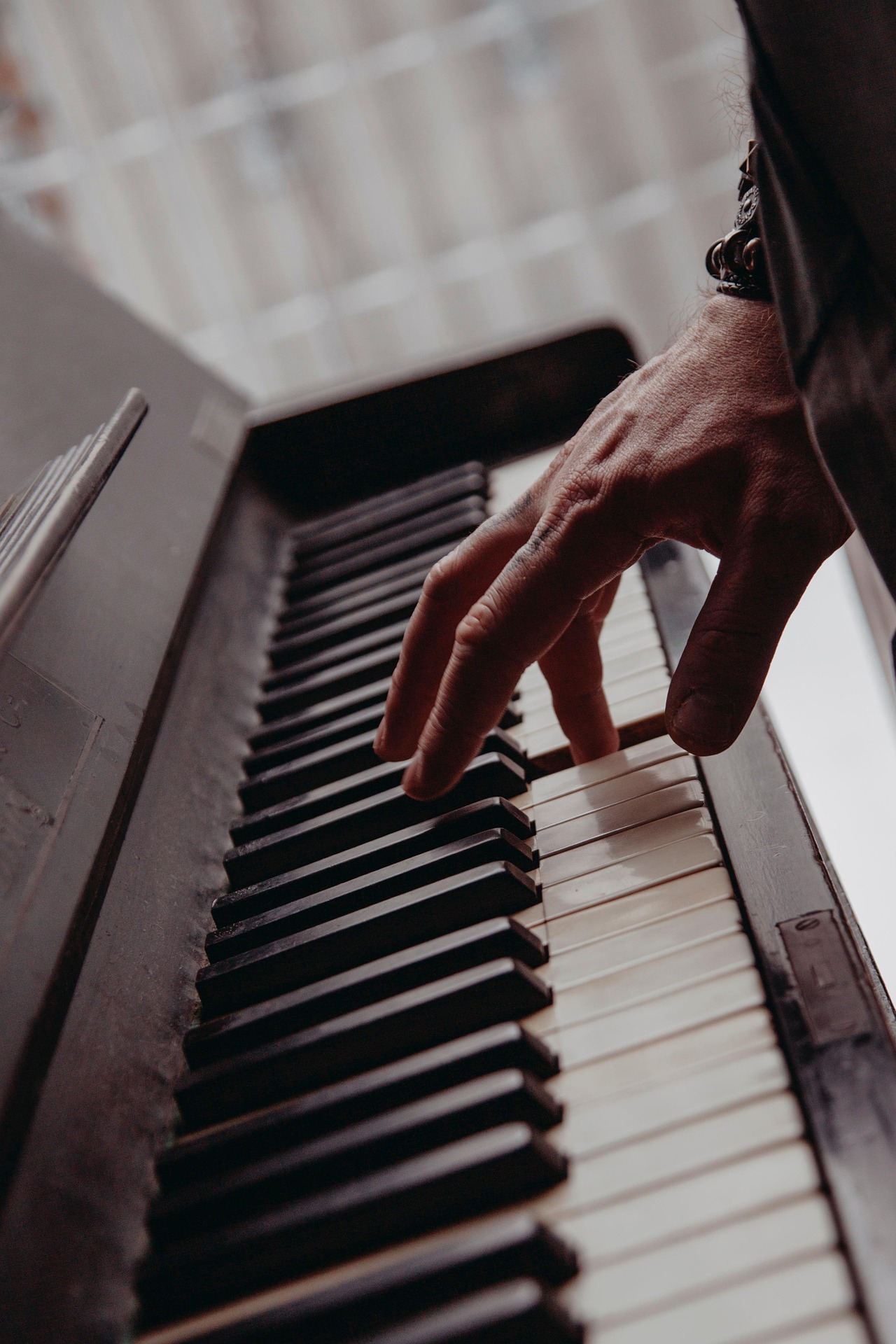
Scott Joplin’s The Entertainer is written in C major, which is a gift to beginners: no sharps, no flats, and the main theme sits right around middle C. The tricky part is not the notes, it is the ragtime feel, where the right hand syncopates against a steady left-hand pulse. Get those two things working together and you have one of the most recognizable tunes on the planet.
Start with the famous right-hand theme
The opening lick is what everyone recognizes. It begins on the D and D# just above middle C, snaps up to E, then walks up a C major arpeggio (C-E-G) before dancing back down. Learn it slowly with these fingers: start with finger 3 on D, use 4 on the D#, and let your thumb tuck under for the arpeggio climb. Play it as straight eighth notes first — no swing, no attitude — just to lock in the pitches.
Only once the notes are automatic do you add the syncopation, which means landing certain melody notes a hair before the beat so they push against the bass. That off-beat accent is the whole personality of ragtime. If counting off-beats trips you up, our guide on how to stop rushing and play in time will steady you first.
The left hand: oom-pah on autopilot
Classic rag left hand alternates a low bass note on beats 1 and 3 with a chord higher up on beats 2 and 4. That is the “oom-pah” engine. For the opening in C, think:
- Beat 1: low C (finger 5)
- Beat 2: a C major chord shape around middle C (fingers 3-2-1)
- Beat 3: low G (finger 5)
- Beat 4: the chord again
Practice the left hand alone until it runs without you thinking about it, because during ragtime your brain has to be free to focus on the syncopated right hand. This is a piece where training each hand separately pays off enormously.
Putting the hands together
Here is the honest part: joining a syncopated melody to a steady bass is the hardest thing in this piece. Slow it down to half speed, even a quarter speed, and use a metronome so the left hand stays rock-steady while the right hand leans off the beat. Do four bars at a time. When it falls apart, it is almost always because the left hand sped up to “help” the right — do not let it. Our guide to using a metronome has a tempo-ramping method that works perfectly here.
Ragtime is really just chord playing with a groove, which is why a chord-based method makes it click faster. Pianoforall teaches that left-hand oom-pah pattern and the chord shapes behind it early on, so a piece like The Entertainer stops feeling like a wall and starts feeling like a pattern you already know.
Make it sound like a real rag
Keep it crisp and mostly un-pedaled — ragtime is bouncy and clear, not blurry. A tiny dab of pedal on the bass notes is fine, but if you drown it in sustain you lose the snap. Once the first strain is solid, you can add the B section, which moves the same patterns to new chords. Beginners often stop after the first two strains, and honestly that already sounds great at a party.
FAQ
What key is The Entertainer in?
The main strain is in C major; later sections move to F and other related keys, but the beginner-friendly opening stays in C.
How long to learn the main theme?
Most beginners get a recognizable version of the first strain in two to three weeks of steady practice, mostly spent on the hands-together coordination.
Do I need to swing the rhythm?
Traditional ragtime is played fairly straight, not heavily swung. The syncopation comes from where notes land, not from a swung eighth feel.
Check the current price of Pianoforall here →
This post contains affiliate links. If you buy through them, we may earn a small commission at no extra cost to you.