

If you’ve ever wondered why certain note combinations sound tense, peaceful, bright, or dark — intervals are the answer. Understanding intervals is one of the most powerful things you can do for your musical development. It unlocks chord theory, helps you learn music by ear, and gives you the vocabulary to understand what you’re playing and why it sounds the way it does.
What Is an Interval?
An interval is simply the distance between two notes — measured in semitones (the smallest step on the piano, one key to the next including black keys). Every interval has a name based on how many scale steps it spans and its quality (major, minor, perfect, augmented, or diminished).
Intervals can be played harmonically (both notes at once) or melodically (one note then the other). Learning to recognise both types by ear is one of the most valuable musical skills you can develop.
The Essential Intervals
Unison (0 semitones): The same note played twice. No distance at all.
Minor 2nd (1 semitone): The smallest possible step — C to C♯, for example. Very tense and dissonant. Think of the Jaws theme.
Major 2nd (2 semitones): A whole step — C to D. Neutral, used constantly in melodies. The opening of “Happy Birthday.”
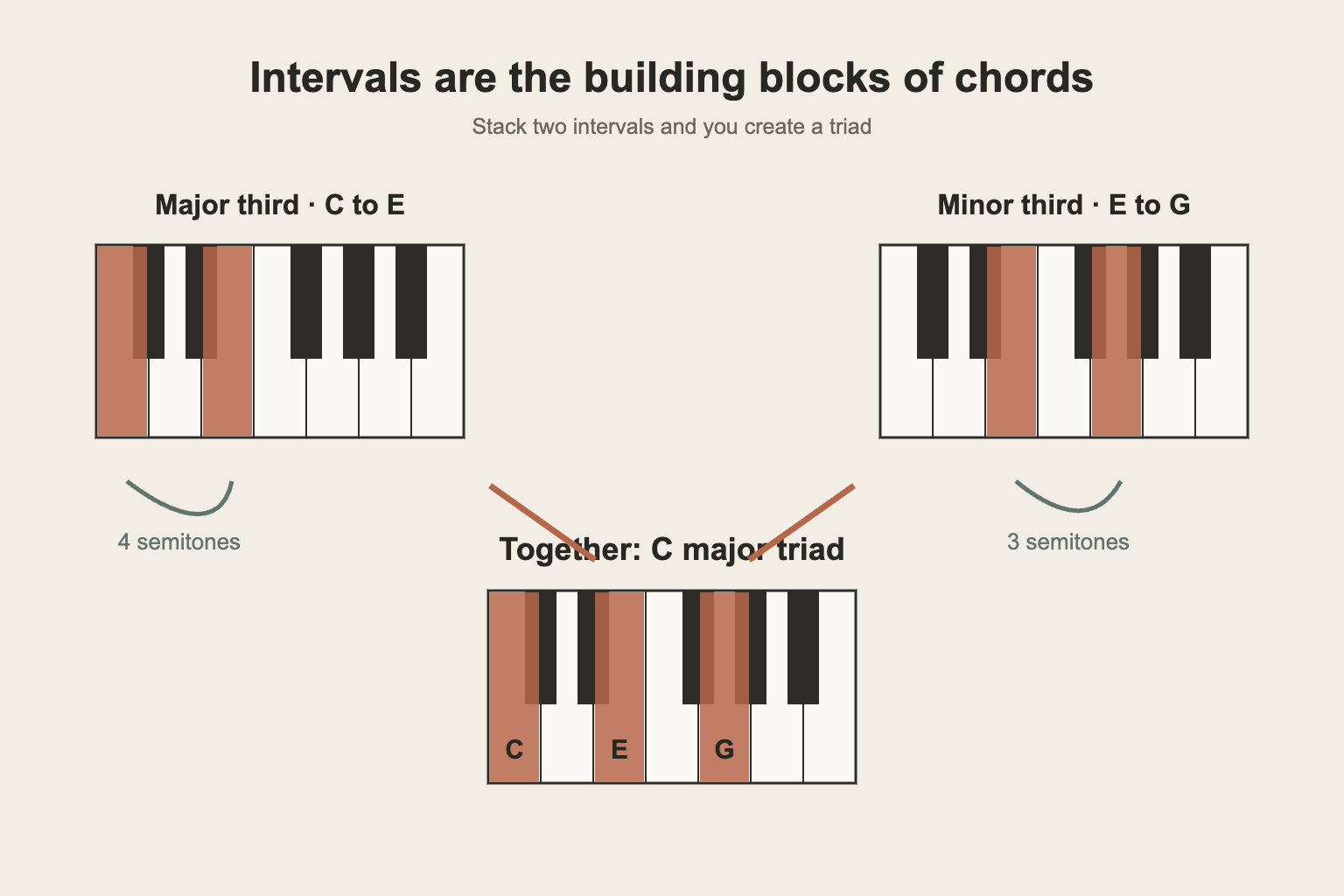
Minor 3rd (3 semitones): The interval that gives minor chords their darker sound. C to E♭. Think of the opening of “Smoke on the Water” or “Greensleeves.”
Major 3rd (4 semitones): The interval that makes major chords bright and happy. C to E. “When the Saints Go Marching In” starts with a major third.
Perfect 4th (5 semitones): Open and stable. C to F. “Here Comes the Bride” opens with a perfect fourth.
Tritone (6 semitones): Exactly halfway through the octave. Very tense — historically called “diabolus in musica” (the devil in music). C to F♯. Creates the characteristic tension of a dominant seventh chord.
Perfect 5th (7 semitones): Powerful and stable. C to G. The power chord in rock music. “Twinkle Twinkle Little Star” uses a perfect fifth on its first big jump.
Minor 6th (8 semitones): Slightly melancholic. C to A♭. Used frequently in Romantic-era classical music.
Major 6th (9 semitones): Sweet and bright. C to A. “My Bonnie Lies Over the Ocean” opens with a major sixth.
Minor 7th (10 semitones): Smooth and slightly tense. C to B♭. The characteristic sound of a dominant seventh chord.
Major 7th (11 semitones): Lush, jazzy, almost longing. C to B. Common in jazz harmony and modern pop.
Octave (12 semitones): The same note one register higher. C to C. Perfectly consonant — the strongest sense of resolution.
Why Intervals Matter for Piano Players

Chords are built from stacked intervals. A major chord is a major third plus a minor third. A minor chord is a minor third plus a major third. A dominant seventh chord adds a minor seventh on top of a major chord. Once you know your intervals, you can build any chord from scratch — no memorisation required, just calculation.
Intervals also help you learn music by ear. When you hear a melody, you’re hearing a sequence of intervals. Train yourself to recognise common intervals by their sound — using the famous song associations — and you’ll start to be able to pick out melodies without sheet music.
How to Practice Interval Recognition
The best approach is dual-track: practice them at the piano (play each interval and say its name out loud) and practice ear training away from the piano (sing or hum intervals, use an ear training app; if pitching them back accurately is the hard part, our sister site’s guide to singing in tune tackles exactly that). Apps like Tenuto, EarMaster, or even the free exercises on musictheory.net are excellent for developing interval recognition by ear.
Focus on perfect intervals and thirds first — unison, octave, perfect fifth, perfect fourth, major third, minor third. These cover the most musical ground. Then add sixths, sevenths, and the tritone.
Intervals are the doorway to chords
Once intervals click, chords stop being shapes to memorise and start being something you can build. A course that teaches chords systematically compounds this quickly. Our Pianoforall review covers how it handles chord construction and where it takes you after the basics.
Read our Pianoforall review →Intervals are the atoms of music. Everything — chords, scales, melodies, harmony — is built from them. Learning your intervals gives you an analytical framework for understanding any music you encounter, and training your ear to recognise them gives you the ability to play music you hear. Both skills take time but both are absolutely worth developing alongside your piano practice.
Looking for a comprehensive piano course? Read our review of Pianoforall — online video lessons plus interactive ebooks for a one-time $49 payment.
Disclosure: Some links on this page are affiliate links. If you purchase through them, we may earn a small commission at no extra cost to you. We only recommend products we genuinely believe in.