
Chords are the backbone of most piano music. If you can read chord symbols and understand how they’re built, you can play along to almost any song, improvise accompaniments, and understand why progressions sound the way they do. Here’s how to decode chord notation from scratch.
What a Chord Symbol Tells You
Chord symbols are the letters and numbers you see above lead sheets and chord charts — things like Cm, G7, Fmaj7, or Bdim. Each symbol tells you two things: the root note (the letter) and the chord quality (the number or abbreviation after it).
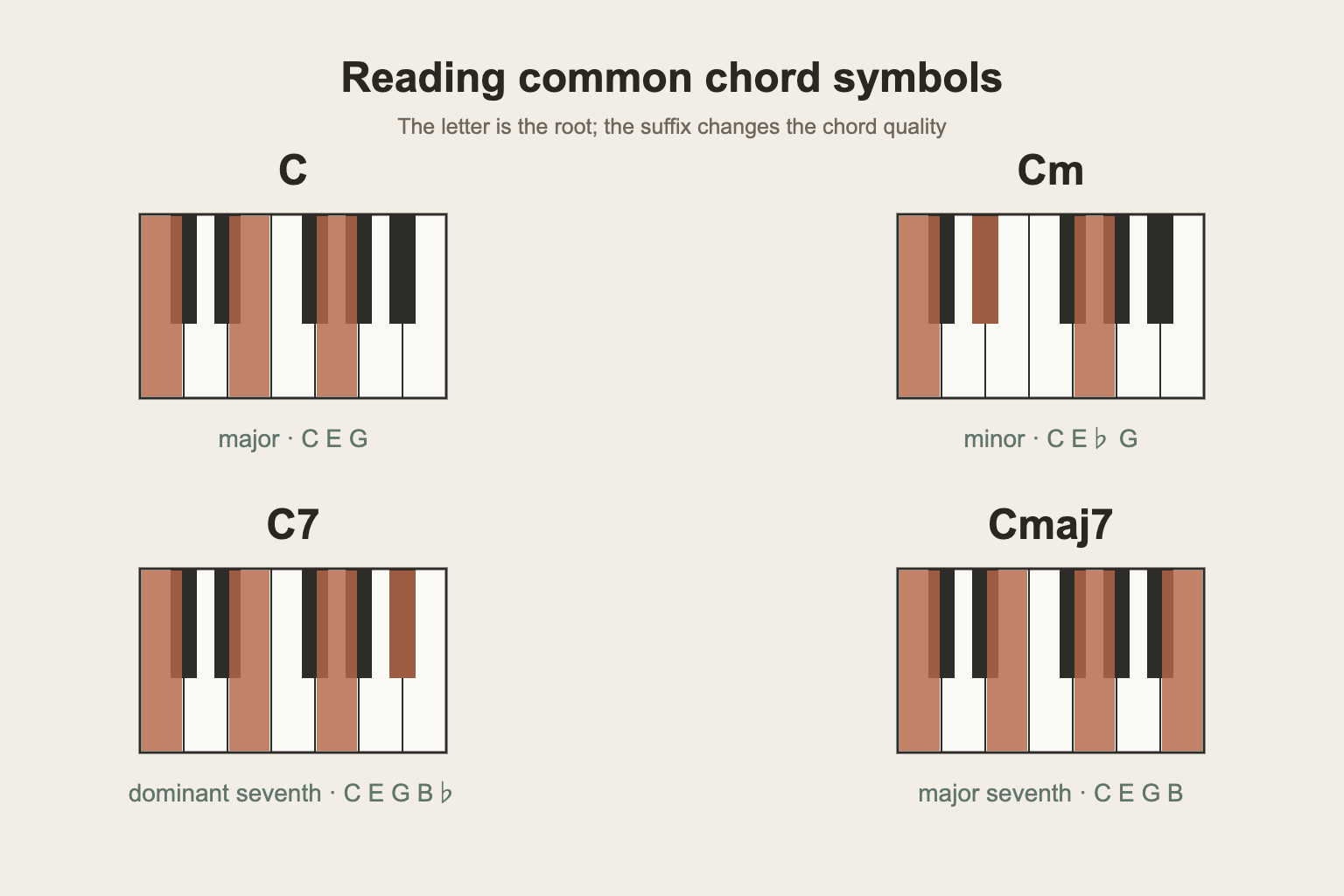
The root note is simply the note the chord is built on. A C chord is built on C. A G chord on G. The quality tells you the mood and interval structure — whether it’s major (bright), minor (darker), dominant seventh (tense), and so on.
Major Chords: The Foundation
A major chord has three notes: the root, a major third above it (4 semitones up), and a perfect fifth above the root (7 semitones up). On the piano, a C major chord is C + E + G. An F major chord is F + A + C. A G major chord is G + B + D.
The formula — root + 4 semitones + 3 semitones — gives you every major chord. Count the keys (including black keys) from the root, and you’ll always land on the right notes. Major chords are written as just the letter: C, F, G, D, A, etc.
Minor Chords: The Same But Darker
Minor chords differ from major by just one note — the middle note drops by a semitone. Instead of 4+3 semitones, minor chords use 3+4. So C minor is C + E♭ + G. The middle note (the third) is flattened, which is what gives minor chords their characteristic darker, more melancholic sound.
Minor chords are written with a lowercase “m” after the root: Cm, Fm, Am, Em. Some notation uses “min” instead — Cmin, Fmin — but these mean the same thing.
Seventh Chords: Adding Colour
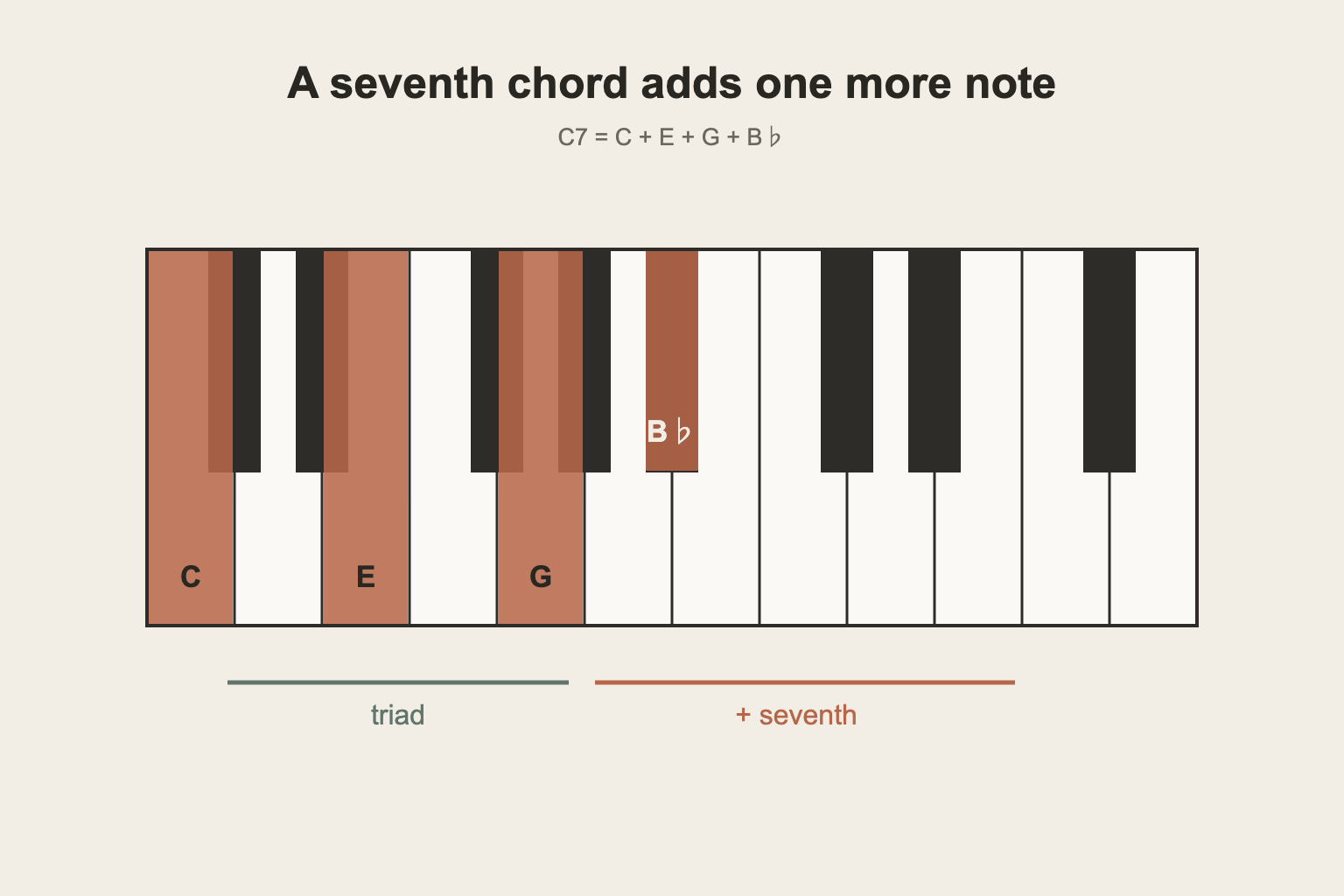
Seventh chords add a fourth note — the seventh — on top of the basic three-note triad. The most common types are:
- Dominant 7th (G7, C7): Major chord + flattened seventh. Very common in blues and jazz. Creates tension that wants to resolve.
- Major 7th (Cmaj7, Fmaj7): Major chord + natural seventh. Lush, jazzy sound. Common in bossa nova and modern pop.
- Minor 7th (Cm7, Am7): Minor chord + flattened seventh. Smooth and mellow. The basis of most jazz minor voicings.
Other Chord Types You’ll See
Suspended chords (sus2, sus4): The third is replaced by the second or fourth. Creates an open, unresolved sound. Common in pop music — think the intro to “Pinball Wizard” or many Coldplay songs.
Diminished (dim or °): Built from stacked minor thirds. Tense and unstable — used for dramatic effect or to transition between chords.
Augmented (aug or +): A major chord with a raised fifth. Dreamy and unresolved. Less common but distinctive when it appears.
Add chords (add9, add11): A basic triad with an extra note added — no seventh implied. Cadd9 is C + E + G + D, for example.
Slash Chords: Bass Note Instructions
Slash chords look like C/E or G/B — a chord symbol with a note after the slash. The note after the slash tells you what to play in the bass (lowest note), regardless of what the chord is. C/E means play a C chord but with E in the bass. This creates smooth bass movements between chords and is very common in pop and classical music.
Building Your Chord Vocabulary
Start by learning all 12 major chords and all 12 minor chords — that’s 24 chords total and it covers the vast majority of what you’ll encounter in pop and folk music. Practice them in order around the circle of fifths: C, G, D, A, E, B, F♯, D♭, A♭, E♭, B♭, F. Play each one, name it, and move on.
Once those are solid, add dominant sevenths (the most common seventh chord type) and you’ll be equipped for blues, jazz, and most popular songs.
The Bottom Line
Reading chord symbols is a systematic skill — not intuition. Learn the major formula (root + 4 + 3 semitones), learn the minor adjustment (root + 3 + 4), and build from there. With 24 major and minor chords memorised and a basic understanding of seventh chord types, you can read and play the harmony of most songs you’ll ever encounter.
Looking for a comprehensive piano course? Read the budget course we recommend — 10 eBooks with audio and video for a one-time price.
Disclosure: Some links on this page are affiliate links. If you purchase through them, we may earn a small commission at no extra cost to you. We only recommend products we genuinely believe in.