
Simply Piano is one of the most downloaded piano learning apps of all time, and it earns that reputation in some areas while falling short in others. Here’s what you actually get — and whether it’s the right choice for you.
Quick answer: Simply Piano is free to download but only as a preview; the full course needs a subscription. At the time of writing the Individual plan is $169.90 a year (about $14.16 a month, with a 14-day free trial) or $17.90 a month with no trial. Prices change, so check the current ones before you pay.
Simply Piano is one of the easiest piano apps to start with: polished, beginner-friendly and very guided. If that app-first experience is what you want, it is a solid choice. But if you simply want to start learning songs, go at your own pace and see how far you take piano without committing to an ongoing subscription, I would choose Pianoforall instead. You pay once and learn on your own schedule.
Is Simply Piano Free?
Short answer: no, not in any meaningful sense. Simply Piano is free to download and gives you a small slice of introductory content — roughly the first course and a handful of lessons. That is enough to see whether you like the interface. It is not enough to learn to play.
Here is exactly what the free tier includes and where the wall appears:
- Free forever: app download, account creation, the first introductory course, and a small number of beginner songs
- Free trial: a 14-day free trial of the full curriculum on the yearly plans (Individual and Family)
- Paywalled: the complete course path, the full song library, chord courses, and all intermediate content
Two things catch people out. First, the app asks for payment details up front on the trial, so it renews automatically unless you cancel before the trial ends. Second, because billing runs through the App Store or Google Play, you cancel in your device subscription settings — not inside the Simply Piano app itself.
The free tier is really a preview — enough to see the interface, not enough to learn the instrument end to end. The no-cost way to properly try Simply Piano is the free trial, which opens up the full lesson path so you can judge whether the guided, gamified format suits you before you pay. Prefer to pay once and keep your lessons forever instead of subscribing? A one-time course is a solid alternative, and we compare both approaches below.
Want to test it yourself? The free trial is the only honest way to know whether the format suits you. Start the Simply Piano free trial → — just set a calendar reminder before it renews.
Most people looking for a free version are not really after free — they are after “not another monthly bill”. Simply Piano is a subscription: about $17.90 a month, or roughly $169.90 for a year at the time of writing. Pianoforall works the other way round: about $49 once, and it stays yours.
It is a trade-off, not a free lunch. Pianoforall is a self-paced course (video lessons and downloadable ebooks, now delivered through the Pianoforall Academy), so there is no real-time feedback and it is a more self-directed experience than an app. What you get instead is depth — chords, blues, jazz, improvisation — and no renewal date. And you have 60 days to try it, with a money-back guarantee if it is not for you.
How Much Does Simply Piano Cost? (2026 Pricing)
Simply Piano uses a subscription model. The free tier gives you the first few lessons and one course — enough to test the interface, not enough to learn meaningfully. The paid plans as of 2026:
- Individual · yearly: $169.90/year (about $14.16/month, 43% off) with a 14-day free trial
- Family · yearly: $209.90/year (about $17.49/month, 50% off) — adds Simply Draw, Simply Guitar and Simply Sing across 5 profiles, with a 14-day free trial
- Individual · monthly: $17.90/month (28% off), no free trial
- Family · monthly: $23.90/month (31% off), all four apps and 5 profiles, no free trial
| Simply Piano plan | Per month | Billed | Free trial |
|---|---|---|---|
| Individual — yearly | $14.16/mo | $169.90/year (43% off) | 14 days |
| Individual — monthly | $17.90/mo | month to month | — |
| Family — yearly | $17.49/mo | $209.90/year (50% off) | 14 days |
| Family — monthly | $23.90/mo | month to month | — |
Good news: the current discount is applied automatically through our link — no coupon code to hunt for. You can start the free trial to check today’s price.
See Simply Piano plans and the 14-day free trial →
Free trial on the yearly plans only. Cancel in your App Store or Google Play settings before it renews.
Pianoforall: about $49 once, 60-day guarantee →
One-time payment, no subscription. Prefer the details first? Read our Pianoforall review.
The annual plan is the realistic minimum commitment — monthly pricing is expensive for what you get, and most learners need 6–12 months before real progress shows. Which is where the arithmetic starts to matter.
$644
$510
$49
What Simply Piano Is
Simply Piano (by JoyTunes) is a mobile app that uses your phone’s microphone to listen to your playing and guide you through songs in real time. It’s gamified — you earn points, unlock songs, and progress through levels. The app covers beginner technique through intermediate repertoire, with content spanning classical, pop, and original exercises.
The User Experience
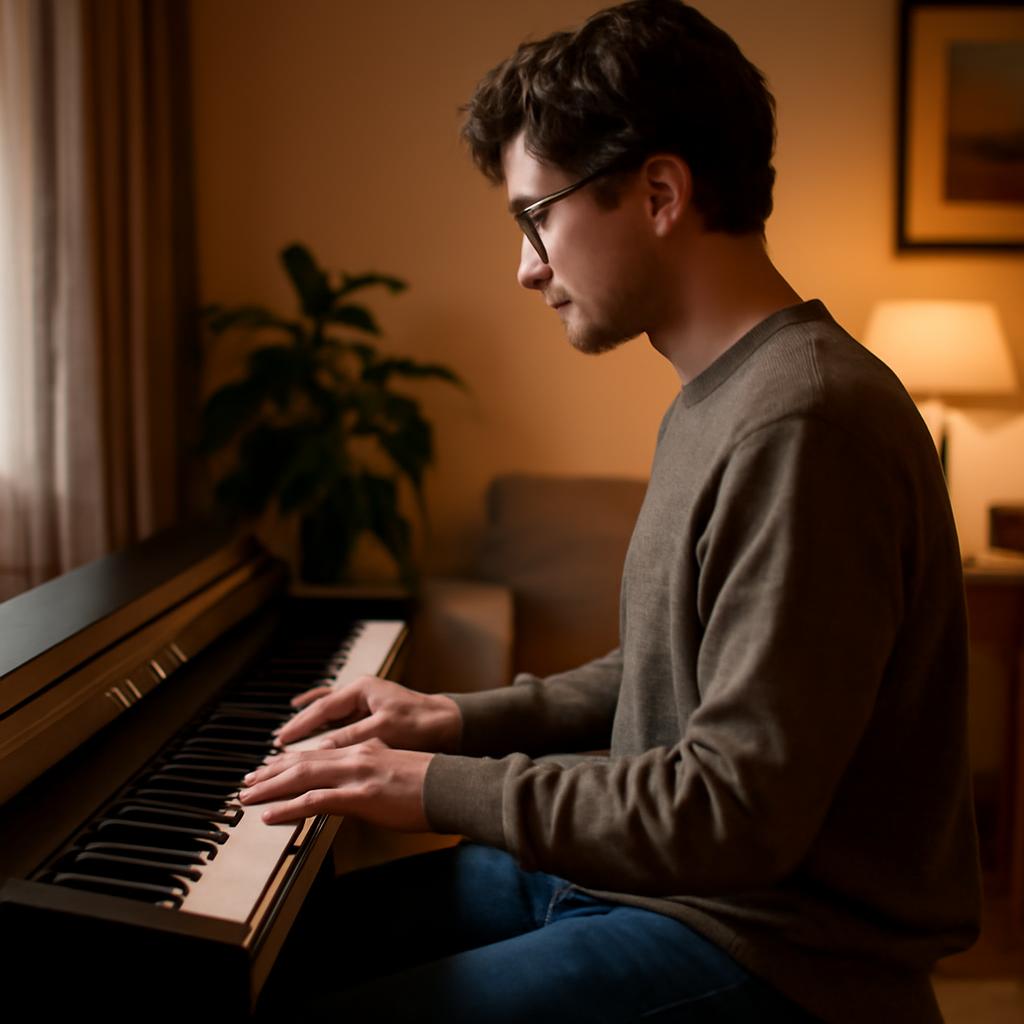
Simply Piano’s interface is polished and engaging. The gamification is well-executed — not patronizing, just present enough to make regular practice feel rewarding. The progression system is clear, the note tracking is accurate (with a good microphone and decent acoustics), and the lesson design for beginners is solid. First impressions are genuinely positive.
Where Simply Piano Excels
For children and teenagers. Simply Piano’s gamified format works particularly well with younger learners who respond to points, levels, and unlocking content. It’s one of the best options for parents wanting to engage children with piano.
Early engagement. The app does an excellent job of keeping beginners engaged through the early weeks, which is one of the hardest problems in piano learning.
Song selection. A good mix of recognizable songs at beginner level gives students early wins with music they actually know.
Where Simply Piano Has Limits
Ceiling effect. Beyond intermediate song playing, Simply Piano’s educational depth is limited. Students can work through the full app without developing the chord knowledge, music theory, or improvisation skills that constitute real musicianship.
Adult experience. Adults often find the gamification superficial rather than motivating. The format appeals strongly to younger learners; adult beginners looking for substantive musical education often find it frustrating.
Cost vs depth. At roughly $170–$210/year, Simply Piano’s educational content doesn’t justify the price point when compared to what comprehensive curricula offer for less.
That ceiling is the single most common reason adults leave Simply Piano after a year. If it applies to you, the honest alternative is a course rather than an app — our Pianoforall review covers the option most adult readers end up choosing.
Simply Piano vs Flowkey: Key Differences
These two apps dominate the piano-learning app market, and they take meaningfully different approaches:
Simply Piano is gamified and structured. It walks you through a fixed curriculum with points, levels, and progression gates. The note detection is accurate with a real piano or keyboard. The lesson design prioritizes engagement and early wins.
Flowkey is less gamified and more library-oriented. It offers a large catalog of songs at various difficulty levels plus structured courses. The teaching style is more “watch and learn” with a more sophisticated visual presentation. It tends to appeal to adults who want to learn specific songs rather than follow a rigid curriculum.
For absolute beginners who need structure: Simply Piano has the edge. The gamification keeps you moving forward even on days you do not feel like practicing.
For adults who want depth and flexibility: Flowkey generally wins. The song library is larger, the visual quality is higher, and the approach treats you more like an adult learner.
For long-term musical education: neither app goes deep enough. Both plateau around the early intermediate level. Adults who want real chord knowledge, improvisation, and music theory should consider a comprehensive course like Pianoforall instead.
Read our full Flowkey vs Simply Piano comparison for a detailed side-by-side breakdown.
Simply Piano vs Pianoforall: Different Models Entirely
Simply Piano and Pianoforall solve different problems for different learners. Neither is automatically better; the right choice depends mostly on how much guidance you want, how you prefer to pay, and whether your goal is app-based practice or more independent playing.
| Feature | Simply Piano | Pianoforall |
|---|---|---|
| Pricing model | Monthly or yearly subscription | About $49 one-time |
| Learning style | Highly guided, app-first progression | Self-paced course built around chords, rhythm and patterns |
| Feedback | Interactive note detection and app feedback | No real-time note detection; more self-directed |
| Best fit | Beginners who want the app to lead each session | Adults who want to understand chords and play more independently |
| Access | Access while subscribed | Lifetime access; 60-day money-back guarantee |
Choose Simply Piano if you want a polished app, clear step-by-step direction and interactive feedback telling you what to do next. That structure is a real advantage for complete beginners who do not want to plan their own practice.
Choose Pianoforall if you want to start learning songs at your own pace, practise when it suits you and keep coming back to the course without worrying about another subscription renewing. It is more self-directed than Simply Piano, but the one-time price makes it an easy way to give piano a proper try on your own schedule.
For an adult beginner who mainly wants to see whether piano becomes something they genuinely enjoy — without signing up for an ongoing subscription from day one — Pianoforall is the option I would pick. You can read our full Pianoforall review for the detailed curriculum, strengths and limitations before deciding.
Which Should You Buy First?
Most comparisons treat this as a either/or decision you make once. In practice it is a sequence, and the order matters more than the choice — because one of these two options is refundable and the other is a commitment.
Start with the one that costs least to be wrong about. Pianoforall is around $49 once, with a 60-day money-back guarantee through ClickBank. Two months is long enough to find out the thing you actually need to know at the start, which is not “is this the best method?” but “am I going to sit down at the piano four times a week?”. If the answer turns out to be no, you get your money back. If you had started on an annual subscription instead, you would be eleven months into a plan you are not using.
Then add the app only if you can name what is missing. After a couple of months of chord-first practice you will know whether the gap is motivation or accuracy. If you keep skipping practice and need something that nags you and rewards streaks, that is exactly what Simply Piano is built for and it is worth the subscription. If you keep playing wrong notes without noticing, the real-time feedback is worth it too. Those are good reasons. “I have not opened it in three weeks” is not.
When to skip Pianoforall and go straight to Simply Piano. If you are buying for a child or a teenager, if you know from experience that you abandon anything self-directed, or if you want to be playing a specific song this weekend rather than understanding how music works — take the 14-day trial and do not overthink it. The chord-first route rewards patience, and not everyone is in the mood for that, which is a perfectly reasonable thing to know about yourself.
What we would not do is buy both at once. They teach in opposite directions, and splitting thirty minutes a day across two methods is the fastest way to make slow progress at both.
Decided already? Get Pianoforall — about $49 once, 60-day guarantee →
Or read the full review first if you want the detail on what is inside.
Who Simply Piano Is Best For
- Children and teenagers who respond well to gamification and need external motivation to practice regularly
- Complete beginners who want a structured introduction without committing to a course or teacher
- Casual learners who want to play recognizable songs quickly and are not focused on deep musical understanding
- People testing whether they enjoy piano before investing in a more comprehensive learning path
If that sounds like you, you can check the Simply Piano free trial here →. This is the case where I think the app-first route genuinely makes sense.
Who Should Look Elsewhere
- Adults who want comprehensive musicianship — chord knowledge, theory, improvisation, multiple genres. Pianoforall or a teacher is a better fit.
- Intermediate players looking to advance — Simply Piano tops out at early intermediate level
- Budget-conscious learners over a 12-month horizon — the subscription cost adds up compared to one-time alternatives
- Learners who dislike gamification — the points-and-levels system is embedded throughout and cannot be turned off
Is Simply Piano Worth It in 2026? The Verdict
Simply Piano is worth it for a specific person: a complete beginner — often a child, teenager, or an adult who knows they need external motivation — who wants a structured, encouraging first six to twelve months. For that person, the annual plan at about $14/month (billed $169.90 a year) is fair value and the app does its job well.
It stops being worth it in two situations. If you already play a little, you will hit the ceiling fast and resent paying a subscription for content you have outgrown. And if your goal is to understand music — chords, theory, improvisation, playing from a lead sheet — the depth simply is not there at any price. For that audience a structured course produces better results at significantly lower total cost.
If you want a highly guided app with feedback, Simply Piano remains a sensible choice. If you would rather start learning songs at your own pace, pay once and have the freedom to keep learning on your own schedule, I would choose Pianoforall.
Frequently Asked Questions
Is Simply Piano free?
Simply Piano offers a limited free tier with access to the first few lessons. The yearly plans include a 14-day free trial that unlocks the full curriculum, after which the Individual plan is $169.90/year (about $14.16/month).
How much does Simply Piano cost?
The Individual plan is $169.90/year (about $14.16/month) or $17.90/month; the Family plan, which adds Simply Draw, Simply Guitar and Simply Sing for up to 5 profiles, is $209.90/year (about $17.49/month) or $23.90/month. Discounts are applied automatically at checkout, and yearly plans include a 14-day free trial. Over three years the Individual annual plan comes to roughly $510, and the monthly plan to roughly $644. Prices are approximate at the time of writing.
Does Simply Piano have a monthly plan?
Yes. Alongside the yearly plans, Simply Piano sells month-to-month subscriptions: $17.90/month for the Individual plan and $23.90/month for the Family plan (which adds Simply Draw, Simply Guitar and Simply Sing across 5 profiles). The monthly plans let you cancel anytime but do not include the 14-day free trial, and they work out more expensive than paying yearly if you stick with the app for six months or more.
Is Simply Piano worth it in 2026?
For children and casual adult beginners who want gamified learning, it provides good value at the annual price point. For adults seeking comprehensive musical education, alternatives like Pianoforall offer more depth at lower total cost.
Is Simply Piano good for adults?
It works for adults who respond well to gamification and whose primary goal is playing specific recognizable songs. Adults who want to understand music rather than just reproduce it often find it unsatisfying beyond the beginner stage, and many outgrow the app faster than younger learners.
Can Simply Piano teach you to read sheet music?
Simply Piano teaches basic note reading as part of its curriculum. However, it prioritizes recognition within the app over independent sight-reading ability. Many users report difficulty reading sheet music outside the app environment.
Does Simply Piano teach music theory?
Minimally. Basic concepts are introduced as they come up in songs, but it is not a systematic theory education. Adults who want to understand how music works should look at Pianoforall or dedicated theory resources.
Does Simply Piano work with a keyboard?
Yes. Simply Piano works with acoustic pianos, digital pianos, and MIDI keyboards connected via USB or Bluetooth. It also works with the device microphone detecting notes from any piano, though MIDI connection is more reliable.
How long does it take to learn piano with Simply Piano?
Most users complete the beginner courses in 3-6 months with regular practice. The intermediate content takes another 3-6 months. Simply Piano is best seen as a 6-12 month learning tool rather than a lifelong solution.
Is Simply Piano better than a piano teacher?
A good piano teacher provides personalized feedback, corrects technique in real time, and adapts to your specific weaknesses. Simply Piano cannot do any of these things. The app is a useful supplement or starting point, not a replacement for human instruction.
Can I cancel Simply Piano anytime?
Yes. Subscriptions can be cancelled through your App Store or Google Play account. Cancellation stops future charges but does not provide refunds for the current billing period.
What is the best alternative to Simply Piano?
For adults: Pianoforall offers the most comprehensive education at a one-time price. For app-based learning: Flowkey provides a similar experience with less gamification and more song variety. For structured courses: Playground Sessions offers a middle ground between app and course.
What to read next
- Beginner Roadmap
- Learning Piano as an Adult
- Building a practice routine that sticks
- Pianoforall Review
How we reviewed this (updated 16 October 2026): this page is based on the vendor’s official information, pricing and policies and on public user feedback. We have not hands-on tested Simply Piano.
Disclosure: This post contains affiliate links. If you purchase through our links, we may earn a small commission at no extra cost to you. We only recommend products we genuinely believe in. See our affiliate disclosure.